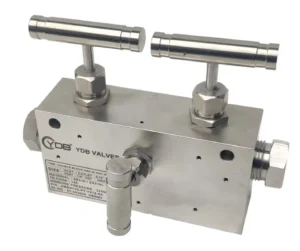
In complex process monitoring networks, sensitive pressure instruments require precise isolation, venting, and calibration capabilities to ensure uninterrupted performance. Installing individual piping components for each instrument function increases assembly footprints and introduces multiple connection points. An instrumentation manifold valve addresses these challenges by combining multiple valve ports and isolation mechanisms into a single engineered body.
Understanding what a manifold valve is, how 2-way, 3-way, and 5-way configurations function, and where these assemblies fit into industrial systems helps engineers design compact, leak-resistant measurement loops.
What Is an Instrumentation Manifold Valve?
An instrumentation manifold valve is a compact, multi-port valve assembly engineered for precise control, isolation, equalization, and venting of pressure monitoring instruments. By consolidating primary block, bleed, and equalizer valves into one solid unit, manifold assemblies provide a direct interface between the main process line and sensitive field devices like transmitters, gauges, and pressure switches.
These assemblies operate under pressures up to 6000 PSI and support remote mount or direct mount installations. They allow technicians to isolate instruments for zero-point calibration, routine maintenance, or replacement without shutting down main process streams.
Why Use a Manifold Valve Over Separate Valve Assemblies?
Connecting pressure instruments directly to process pipelines using discrete valves, nipples, and fittings poses mechanical and operational challenges. Key advantages of utilizing integrated manifold assemblies include:
- Fewer Connection Leak Paths: Combining multiple ports into a single forged body eliminates intermediate threaded or welded joints, lowering the risk of pressure leaks and fugitive emissions.
- Compact Physical Footprint: Manifold units fit neatly into tight control panels or directly onto transmitter heads, saving space in dense processing skids.
- Streamlined Maintenance & Calibration: Built-in vent and equalizer channels permit safe inline calibration and instrument zeroing without disconnecting field wiring or fluid lines.
- Reduced Piping Stress: Lower overall assembly weight minimizes vibration fatigue on small-bore instrument connections.
What Are the Key Types of Manifold Valves and How Do They Function?
Manifold valves are categorized based on their internal port configurations and the specific instrument type they support.
1. 2-Valve Manifold Assemblies (2-Way)
A 2-valve manifold is configured primarily for static pressure monitoring using single-port devices, such as standard pressure gauges, pressure switches, or gauge transmitters.
- Internal Configuration: Contains one block (isolation) valve and one drain/bleed valve.
- How It Operates: Under normal operation, the block valve remains open to allow process media to reach the instrument while the bleed valve stays closed. To perform maintenance or calibration, the block valve is closed to isolate process line pressure, and the bleed valve is opened to vent trapped fluid safely into a drain line.
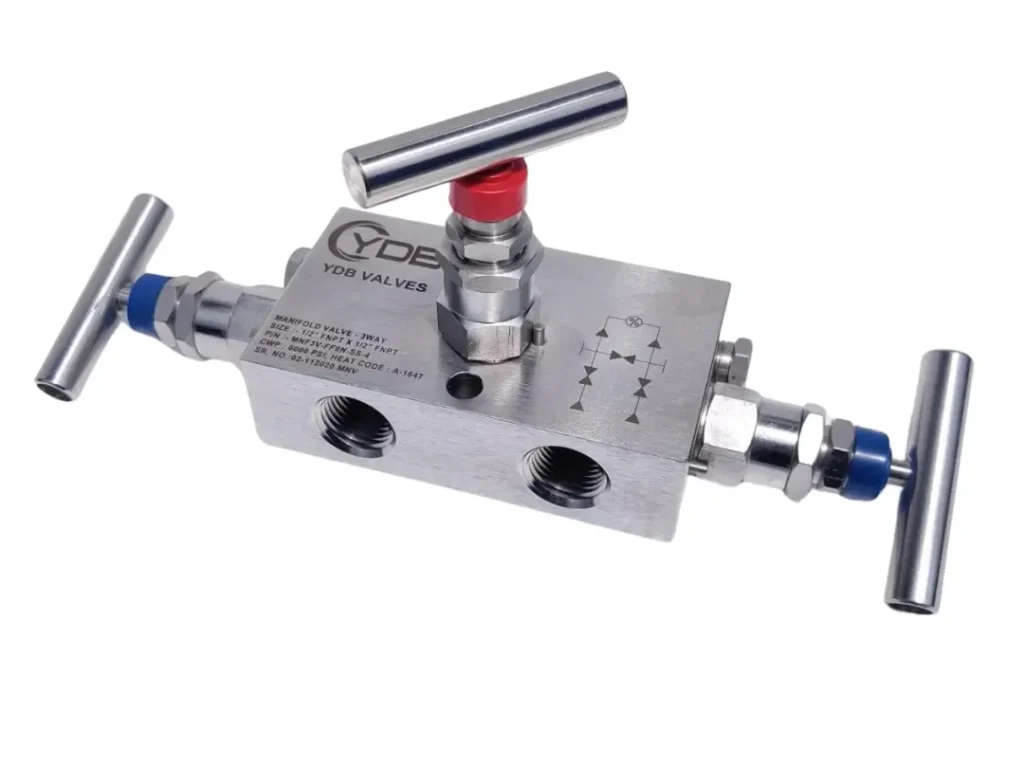
2. 3-Valve Manifold Assemblies (3-Way)
Designed specifically for differential pressure (DP) transmitters, a 3-valve manifold manages dual process inputs (high-pressure line and low-pressure line).
- Internal Configuration: Consists of two block (isolation) valves (one for the high-pressure side and one for the low-pressure side) and one central equalizer valve.
- How It Operates: During standard operation, both block valves are open, and the equalizer valve remains closed. During instrument zeroing or static pressure testing, closing one or both block valves and opening the equalizer valve balances pressure across both sides of the transmitter diaphragm, preventing damage caused by single-sided over-pressure.
3. 5-Valve Manifold Assemblies (5-Way)
A 5-valve manifold provides advanced isolation, equalization, and venting for differential pressure instruments operating in critical high-pressure environments.
- Internal Configuration: Features two main block valves (high and low pressure), one equalizer valve, and two independent vent/bleed valves.
- How It Operates: Similar to a 3-valve setup, the two block valves isolate the process, while the equalizer balances diaphragm pressure. The two dedicated vent valves allow technicians to bleed trapped process media from both the high and low-pressure sides independently, ensuring complete depressurization before removing the instrument.
What Construction Materials and Connection Options Are Available?
Instrumentation manifold assemblies are manufactured to handle diverse temperature, pressure, and chemical conditions across demanding processing units:
- Material Options: Standard bodies are crafted from Stainless Steel 316 (SS316), as well as exotic alloys such as Monel and Hastelloy for aggressive chemical compatibility and corrosion resistance.
- Connection Types: Units accommodate NPT (National Pipe Thread), BSP (British Standard Pipe), or direct flange end connections matching standard 2-1/8 inch center transmitter interfaces.
- Mounting Styles: Available in direct-mount styles (flanged directly to the transmitter body) or remote-mount styles (connected via impulse tubing and panel-mounted).
Where Are Manifold Valves Applied Across Industrial Sectors?
Because of their precise flow control and pressure integrity, manifold valves are implemented across several critical industrial monitoring points.
Pressure & Differential Pressure Transmitters
Mounted directly to transmitters to facilitate inline zero checking, range calibration, and safe field removal without process interruption.
Flow and Level Measurement Systems
Utilized in differential pressure flow measurement loops (such as orifice plate setups) and liquid level monitoring tanks to equalize differential pressures safely.
Chemical Injection & Process Skids
Installed on modular skid packages handling chemical dosing or high-pressure gas distribution, where space constraints demand compact panel-mounted manifolds.
Power & Petrochemical Infrastructure
Employed across oil, gas, chemical processing, and power generation facilities to protect sensitive instrumentation installed along continuous fluid headers.
How to Select the Correct Manifold Valve Configuration?
Choosing the proper manifold valve requires evaluating the instrument type and operational demands:
- Identify Instrument Type: Use 2-valve configurations for static pressure gauges/transmitters; use 3-valve or 5-valve configurations for differential pressure devices.
- Determine Venting Requirements: Select a 5-valve manifold over a 3-valve unit when double isolation and independent venting of high/low process lines are required for safety compliance.
- Check Operating Parameters: Ensure material metallurgy (SS316, Monel, Hastelloy), thread standards (NPT, BSP), and pressure ratings (up to 6000 PSI) align with process media and system requirements.
Frequently Asked Questions (FAQs)
1. What is the main difference between a 3-valve and a 5-valve manifold?
A 3-valve manifold contains two block valves and one equalizer valve, relying on external purge ports for venting. A 5-valve manifold includes two dedicated internal vent valves alongside the block and equalizer valves, allowing complete inline venting of high and low-pressure sides.
2. Why is an equalizer valve necessary in differential pressure manifolds?
The equalizer valve balances pressure between the high-pressure and low-pressure chambers of a differential transmitter. Opening it prevents over-pressurization and potential damage to the transmitter diaphragm during line startup or zero-point calibration.
3. Can manifold valves handle high-pressure applications?
Yes. Instrumentation manifold valves are pressure-rated up to 6000 PSI and engineered for leak-proof performance under high-pressure conditions.
4. What connection options are used for mounting manifold valves?
Manifolds feature NPT, BSP, or direct flange end connections designed to attach seamlessly to impulse piping, mounting brackets, or transmitter flange faces.
5. What materials are commonly used in manifold valve construction?
Common materials include Stainless Steel 316 (SS316), Monel, and Hastelloy to ensure durability, pressure containment, and resistance against corrosive process media.
Quality Manufacturing & Engineering Compliance
Manufacturing reliable instrumentation valves requires strict quality assurance and material precision. YDB VALVES LLP designs and produces high-performance instrumentation components—including instrumentation ball valves, check valves, manifold valves, relief valves, and needle valves—alongside double block & bleed, butterfly, cast steel, and forged steel valve ranges.
Every manifold assembly undergoes comprehensive inspection and testing for material quality and pressure integrity. Complete technical support is provided with installation guidance, technical drawings, and Material Test Certificates (MTCs).
- Head Office Address: YDB VALVES LLP, Y-21, Khan Real Industrial Estate, N. H. 08, Pelhar, Vasai Phata, Vasai East, Palghar – 401208, Maharashtra, INDIA
- Request Information: Share your system requirements on our Request a Quote page.
- Email: info@ydbvalves.com
- Contact Phone: +91-80 8701 0270
- Product Catalog: Download the catalogue for complete engineering diagrams and specification tables.
For custom 2-way, 3-way, or 5-way instrument mounting configurations, consult a certified manifold valve manufacturer in india to select the ideal valve assembly for your process control requirements.