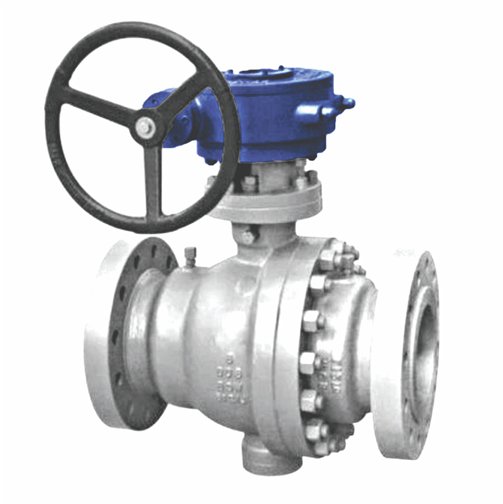
If you are buying ball valves for oil and gas pipelines, chemical and petrochemical plants, power plants, refineries or water treatment, it helps to know what the valve is made of. The body, the ball, the seat, the stem and the seals each have their own features, and the YDB Valves product page lists them clearly.
In this blog, we go through these parts one by one. We also cover the body construction, the material options, the operating conditions, the standards the valves follow and the choices you have when you order, so you know what to look for.
What Are YDB Ball Valves Designed For?
The product page presents the range as reliable isolation for high-performance applications. YDB ball valves are robust shut-off solutions for critical applications. They serve the oil and gas industry, petrochemical plants, power generation and other process industries. Reliability is the starting point of the design, and the valves are built for leak-proof performance and a long service life, even when conditions are harsh.
The valves also have high-pressure and high-temperature capability. Two ball configurations are offered, trunnion and floating, and the parts described below are the ones you will meet across the range.
The Body
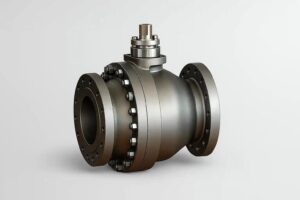
YDB ball valves come in 2-piece and 3-piece construction, and each of these can be had in forged or cast form. Both full bore and reduced bore options are available, so you can choose the bore that suits your line.
The body can be made from a wide range of materials. Carbon steel (ASTM A105) and low temperature carbon steel (ASTM A350 LF2) are on the list, along with stainless steel (ASTM A182 F304 and F316) and cast stainless steel (ASTM A351 CF8 and CF8M). Duplex and super duplex steel (ASTM A182 F51 and F53) and alloy steel (ASTM A217 WC6 and WC9) are also available. Monel, Hastelloy and Inconel can be supplied on request.
NACE MR 01-75 compliance is available for the valve body and trim.
The Ball: Floating or Trunnion
The range offers two ball configurations: trunnion and floating. Both are covered by the same product page, so you can compare them in one place. The page describes the trunnion mounted ball valve through four design features: double block and bleed, double body sealing, fire safe design and multiple stem sealing. You will find these features covered in the seat, seals and fire-safe sections of this blog.
The product page also has a section for ball and stem materials. For the complete material details, the ball valve catalogue is available to download.
The Seat
The product page describes the seat under the design features of its trunnion mounted ball valve. There, spring-loaded floating seats stay in contact with the ball and give tight shut-off even when the pressure differential is low.
The seat also plays a part in the fire-safe design. If a fire breaks out, the soft insert burns away, and the spring-loaded seats take over with metal-to-metal sealing. A separate section on the product page covers seat materials, and the catalogue has the full details.
The Stem
The stem links the actuator or handle to the ball, and YDB ball valves use a blow-out proof stem design. This design enables positive stem retention, which means the stem stays in place.
The sealing around the stem is described in the seals section of the product page, and we cover it next.
The Seals: Body and Stem
Sealing is covered in two places on the product page. The first is body sealing. The upstream and downstream sides are sealed independently, and this makes it possible to drain the fluid from the body cavity. This is what makes double block and bleed operation possible.
The second is stem sealing. A triple sealing arrangement in the stem area prevents leakage to the atmosphere. Within it, an O-ring and a graphite seal give double sealing at the upper end of the stem housing.
The product page also has a section for seal and gasket materials, and the catalogue gives the complete list.
What About Fire-Safe and Antistatic Design?
The product page addresses fire safety directly. YDB ball valves have an antistatic device for fire-safe operation, and the fire-safe and antistatic design is compliant with API 607 and ISO 10497.
The fire safe test follows API 607, API 6FA, BS 6755 Part II and BS EN ISO 10497. Together with the soft insert and spring-loaded seat arrangement described above, this is how the valve is designed to handle a fire.
How Do You Operate the Valve?
YDB ball valves are available with actuators of the manual, gear, pneumatic and electric types. The valve has an actuator mounting pad as per ISO 5211, so the actuator can be mounted directly on the valve.
What About the Connections?
The valve ends and related dimensions follow the standards listed on the product page. Flange dimensions follow ASME B16.5, ASME B16.47 and MSS SP 44, and butt weld valve ends follow ASME B16.25, ASME B31.3, ASME B31.4 and ASME B31.8. Face-to-face dimensions follow ASME B16.10 and API 6D, the valve bore follows API 6D, and drain, vent and bypass connections follow MSS SP 46 and API 6D.
What Standards and Quality Procedures Apply?
The design and manufacture of YDB valves follow ASME B16.34, API 6D and BS 5351 / BS EN ISO 17292. Between them, these standards address the pressure-temperature ratings, the minimum shell thickness and the bore diameter for every size and class.
Castings inspection follows MSS-SP 53, 54, 55, 59, 93 and 94. Pressure tests follow API 6D, API 6FA and BS EN 12266-1 and 2.
Quality procedures at YDB Valves are rigid, controlled and approved to ISO 9001:2015. Critical dimensions, surface finishes, run-out and sharp edges are closely monitored, and each valve is made to meet the requirements of its drawing within the given tolerances. This supports consistent quality and high-performance products.
What Are the Operating Conditions?
The range covers a wide span of conditions. Pressure ratings run from 150# to 2500#. The temperature range is from -46°C to +538°C. Sizes run from ½ inch to 24 inch, and custom sizes are available.
Where Are These Valves Used?
You will find YDB ball valves in oil and gas pipelines, in chemical and petrochemical plants, in power plants and in refineries. They are also used in water treatment and distribution. All five are applications listed on the product page.
What Choices Do You Have When You Order?
The product page gives you a clear set of choices. You can pick a 2-piece or 3-piece body, in forged or cast construction, with a full bore or a reduced bore. You can choose a trunnion or floating ball configuration, and you can pick the body material from the list above. You can select the size, from ½ inch to 24 inch, with custom sizes available, and the pressure rating, from 150# to 2500#. For operation, you can choose the actuator type, whether manual, gear, pneumatic or electric.
A Quick Recap
To sum up the key features of the range: it has 2-piece and 3-piece forged and cast construction, a blow-out proof stem design, an antistatic device for fire-safe operation, and full bore and reduced bore options. The fire-safe and antistatic design is compliant with API 607 and ISO 10497. Trunnion and floating ball configurations are both offered, with high-pressure and high-temperature capability, and the valves can be fitted with the actuator of your choice. On materials and conditions, the body is available from carbon steel to Monel, Hastelloy and Inconel on request, with pressure ratings from 150# to 2500#, temperatures from -46°C to +538°C and sizes from ½ inch to 24 inch.
Where Can You Find the Full Specifications?
For the complete specifications, you can download the ball valve catalogue from our product page. The page also covers the applications, the material options, the operating conditions, the design features and the testing standards.
If you need other valves along with ball valves, YDB Valves LLP also offers double block and bleed valves, instrumentation valves, high pressure needle valves, high pressure DBB needle valves, injection quill valves, butterfly valves, gate, globe and check valves in cast steel and forged steel, and tube fittings. The company website also has pages on About us, Infrastructure, Quality, Certifications, Contacts and Enquiry.
Frequently Asked Questions
1. What are the main parts of a YDB ball valve?
The main parts are the body, the ball, the seat, the stem and the seals. The valve also has an antistatic device for fire-safe operation and an actuator mounting pad as per ISO 5211.
2. Which body constructions are available?
YDB ball valves come in 2-piece and 3-piece construction, in forged and cast form, with full bore and reduced bore options. Both trunnion and floating ball configurations are offered.
3. Which materials can the body be made from?
The body materials include carbon steel, low temperature carbon steel, stainless steel, duplex and super duplex steel, alloy steel and cast stainless steel. Monel, Hastelloy and Inconel are available on request.
4. Which standards do the valves follow?
The design and manufacture of the valves follow ASME B16.34, API 6D and BS 5351 / BS EN ISO 17292. The fire-safe and antistatic design is compliant with API 607 and ISO 10497.
5. What sizes, pressure ratings and temperatures are covered?
Sizes run from ½ inch to 24 inch, with custom sizes available. Pressure ratings run from 150# to 2500#, and the temperature range is from -46°C to +538°C.
Looking for Ball Valves? Talk to YDB Valves
YDB Valves LLP is a pioneer manufacturer and supplier based in Vasai East, Palghar, with good experience in the designing and manufacturing of new concept instrumentation valves. If you need a floating ball valve for your application, you can request a quote or download the catalogue from our website.
Our head office is at Y-21, Khan Real Industrial Estate, N. H. 08, Pelhar, Vasai Phata, Vasai East, Palghar – 401208, India.
- Request a Quote, or write to info@ydbvalves.com or call +91-80 8701 0270
- Download the catalogue to see the full product range